- The 9.5 Origin: CBSE derived 9.5 by analyzing 10 years of student records in the top A1 grade band (91–100%), which statistically clustered around an average of 95%. Dividing 95 by 10 yields 9.5.
- The 10 CGPA Trap: A 10.0 CGPA officially equals 95.0%, never 100%. Claiming 100% on legal or university applications can lead to disqualification.
- University Warnings: Most engineering colleges and universities (VTU, Mumbai University, Anna University) mandate unique formulas like
(CGPA - 0.75) × 10instead of 9.5.
If you have ever stared at an Indian school or college marksheet, one question almost certainly crossed your mind:
"If my CGPA is graded on a 10-point scale, why doesn't a perfect 10 CGPA equal 100%? Why does the Central Board of Secondary Education (CBSE) force millions of students to multiply by the awkward decimal 9.5 instead of a clean, round 10?"
At first glance, it feels like an injustice. Did the board arbitrarily steal 5% of your academic achievements? Is there an actual mathematical rationale behind it, or was 9.5 picked at random by a government committee?
In this investigative deep-dive, we examine the official archives of CBSE’s grading transition, uncover the statistical bell curve that birthed the 9.5 factor, and walk through three real-world student case studies to ensure you never make a disqualifying error on a job application or college entrance form.
1. The Real Story: Where Did 9.5 Actually Come From?
In the 2009–2010 academic session, CBSE made a historic shift from publishing raw percentage marks to adopting the Continuous and Comprehensive Evaluation (CCE) grading framework. Under this system, students were awarded letter grades and grade points from 1 to 10 rather than individual percentages.
The primary goal was noble: to alleviate extreme psychological pressure on students by grouping comparable scores into broader achievement bands. For example, any student scoring between 91 and 100 marks in a subject received an A1 grade and a Grade Point of 10.
However, an immediate real-world collision occurred: scholarship foundations, international universities, and employment forms still demanded an equivalent percentage score. How could a 10-point grade be fairly converted back into a percentage?
The Statistical Bell Curve Analysis
To solve this, CBSE educational statisticians analyzed historical mark sheets from over 1.2 million students spanning the preceding decade. They mapped the raw percentage scores of all students who qualified for the top A1 tier (91% to 100% marks).
| CBSE Grade Band | Raw Mark Range | Grade Point | Historical Cohort Mean |
|---|---|---|---|
| A1 | 91 – 100 | 10.0 | 95.0% |
| A2 | 81 – 90 | 9.0 | 85.0% |
| B1 | 71 – 80 | 8.0 | 75.0% |
| B2 | 61 – 70 | 7.0 | 65.0% |
| C1 | 51 – 60 | 6.0 | 55.0% |
The statistical findings were conclusive: across every subject, the average raw score of students falling inside the 91–100 band was neither 91% nor 100%—it settled at an empirical mean of 95.0%.
To establish a consistent, linear scaling factor between a Grade Point of 10 and the cohort average of 95%, the mathematical relation was defined as:
Multiplier Factor = 95.0% ÷ 10.0 = 9.5
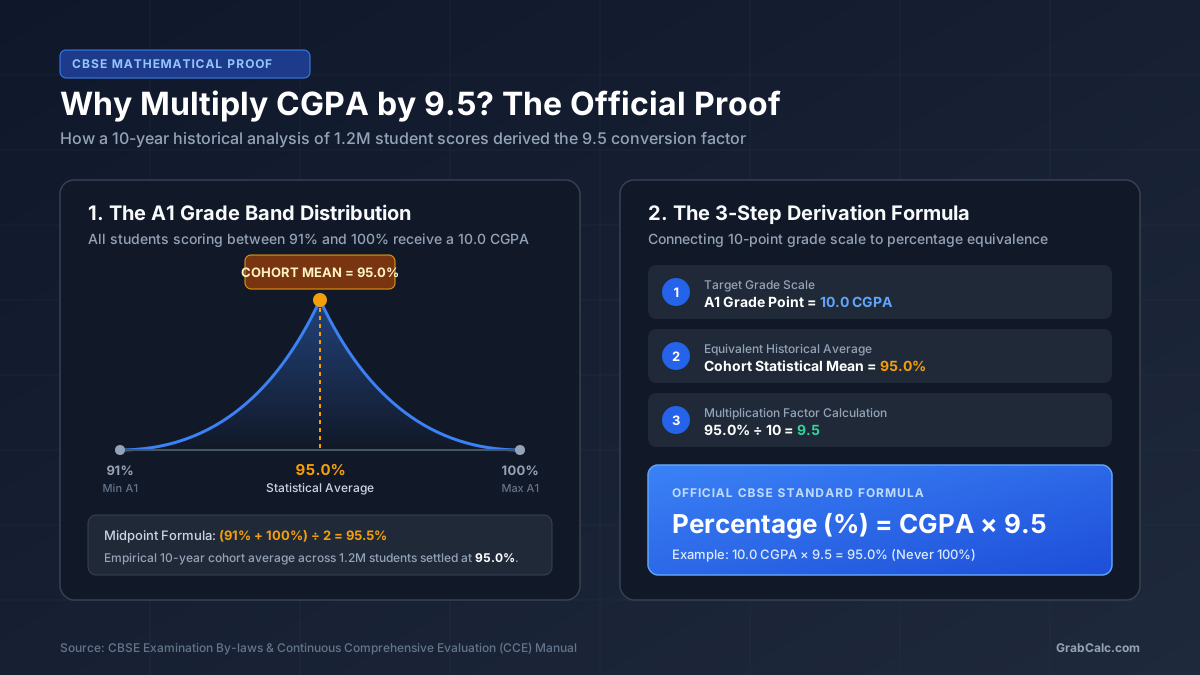
This explains why multiplying by 10 was rejected: if a student who earned 91 raw marks was awarded a 10 Grade Point, multiplying by 10 would yield an inflated 100%, erasing the distinction of someone who actually scored 99 or 100. Multiplying by 9.5 anchors the score to the true statistical center of academic performance.
Need to Convert Your Marks Right Now?
Convert 5 or 6 subjects instantly with our private, client-side calculator.
2. Three Real-World Student Case Studies
To see how this works in practice—and where students commonly make costly errors—let us review three concrete scenarios based on actual transcript submissions.
Rahul received his Class 10 marksheet featuring 5 compulsory academic subjects plus a 6th additional skill subject (Information Technology):
| Subject | Grade | Grade Point |
|---|---|---|
| English Communicative | A2 | 9.0 |
| Hindi Course-A | A1 | 10.0 |
| Mathematics | B1 | 8.0 |
| Science | A2 | 9.0 |
| Social Science | B1 | 8.0 |
| Information Technology (6th Subject) | A1 | 10.0 |
The Costly Mistake: Rahul summed all 6 grade points (54.0) and divided by 6 (9.0 CGPA), resulting in 9.0 × 9.5 = 85.5%.
The Correct Official Method: CBSE guidelines mandate calculating CGPA using the 5 main subjects:
1. Sum of 5 main subjects: 9.0 + 10.0 + 8.0 + 9.0 + 8.0 = 44.0
2. CGPA = 44.0 ÷ 5 = 8.80
3. Percentage = 8.80 × 9.5 = 83.60%
Note: Under CBSE National Curriculum Framework regulations, the 6th vocational subject can only replace Social Science or Science if the student scored a failing grade in that subject or if an applying college specifically requests a "Best of 5" aggregate.
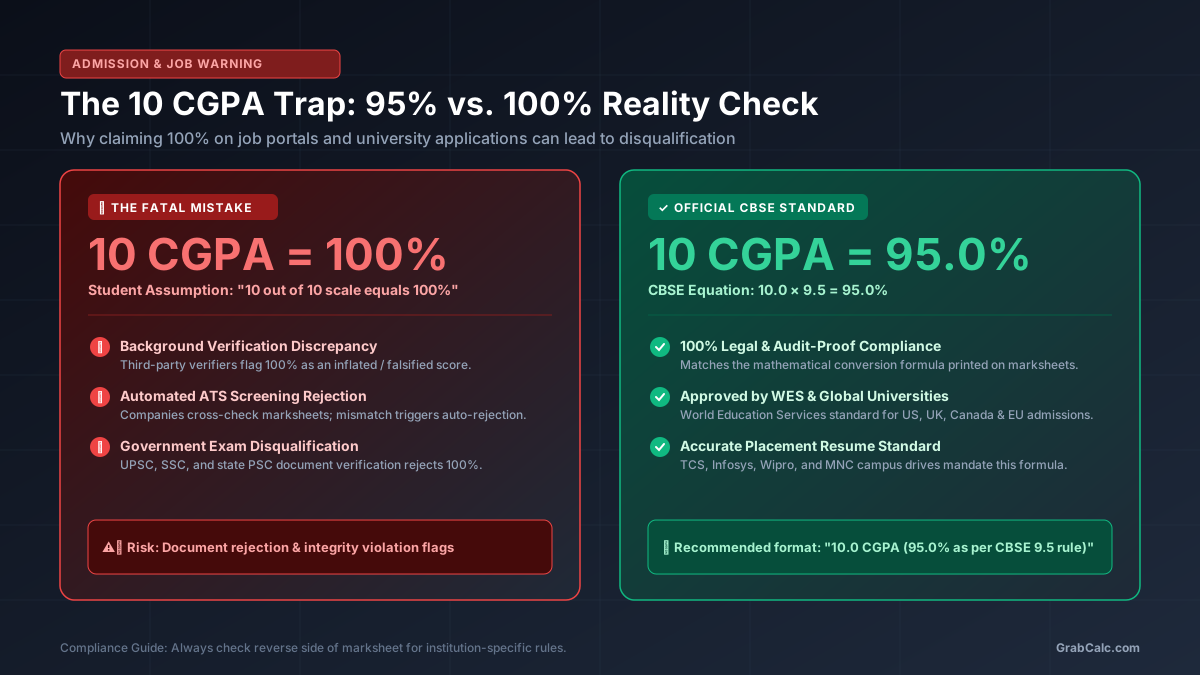
Priya completed her Bachelor of Engineering (B.E.) from Visvesvaraya Technological University (VTU) with a final Cumulative Grade Point Average of 8.20.
When filling out the candidate eligibility portal for an IT MNC requiring a minimum 75.0% aggregate, Priya assumed the standard CBSE rule applied: 8.20 × 9.5 = 77.90%. She checked "Eligible".
During document verification, her offer letter was withheld. Why? VTU does NOT use the 9.5 multiplier.
VTU's statutory conversion formula is strictly defined as:
Plugging in her actual scores: [8.20 − 0.75] × 10 = 7.45 × 10 = 74.50%. Because her true university aggregate was 74.50%, she did not satisfy the 75.0% cutoff.
Arjun applied for an MS in Data Science in the United States. His undergraduate degree from Delhi University reflected a 7.80 CGPA. Confused by internet forums, Arjun multiplied by 9.5 to get 74.1%, and then divided by 25 to estimate a 2.96 / 4.0 GPA.
The Reality: International credential evaluators like World Education Services (WES) never use the 9.5 multiplier. WES recalculates GPA on a course-by-course credit basis. In Indian universities, a 7.80 CGPA is typically classified as "First Class with Distinction", which WES frequently evaluates as a competitive 3.30 to 3.50 on the US 4.0 scale.
Rule of thumb: Never manually convert your Indian CGPA to a US 4.0 scale using simple arithmetic. Submit your native transcripts directly to authorized evaluation bodies.
3. University Conversion Formula Comparison Matrix
Never assume that 9.5 is universal across India. Before filling out state government exam forms (UPSC, SSC), banking exams (IBPS), or corporate placement forms, consult this official matrix:
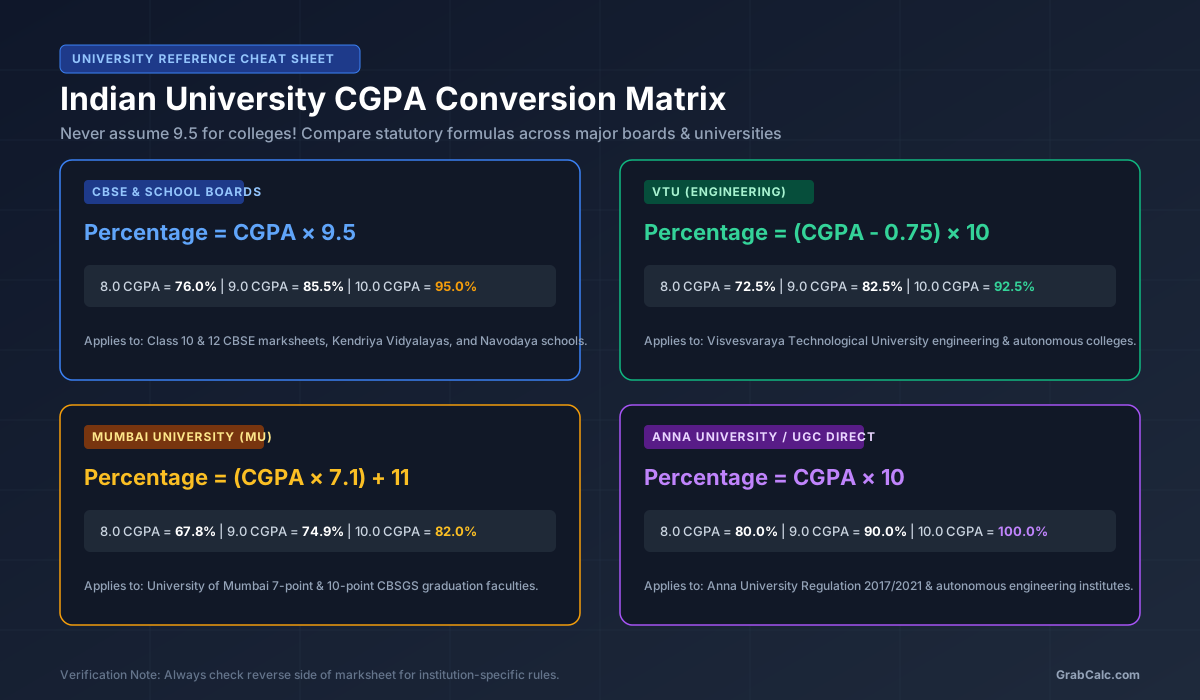
| Academic Board / University | Official Conversion Formula | Example (8.0 CGPA) |
|---|---|---|
| CBSE (Class 10 & 12) | Percentage = CGPA × 9.5 |
76.00% |
| VTU (Visvesvaraya Tech Univ) | Percentage = (CGPA − 0.75) × 10 |
72.50% |
| Mumbai University (Engg) | Percentage = 7.25 × CGPA + 11 |
69.00% |
| Delhi University (DU) | Percentage = CGPA × 9.5 |
76.00% |
| Anna University (Tamil Nadu) | Percentage = CGPA × 10 |
80.00% |
| KTU (Kerala Tech University) | Percentage = (CGPA − 0.75) × 10 |
72.50% |
4. Complete CGPA to Percentage Quick Reference Chart
Use this reference table to look up standard CBSE percentage conversions from 6.0 to 10.0:
| CGPA | CBSE Percentage (× 9.5) | Equivalent Letter Grade | Degree Classification |
|---|---|---|---|
| 10.0 | 95.0% | A1 | First Class with Distinction |
| 9.8 | 93.1% | A1 | First Class with Distinction |
| 9.5 | 90.25% | A1 | First Class with Distinction |
| 9.0 | 85.5% | A2 | First Class with Distinction |
| 8.5 | 80.75% | A2 / B1 | First Class with Distinction |
| 8.0 | 76.0% | B1 | First Class |
| 7.5 | 71.25% | B1 | First Class |
| 7.0 | 66.5% | B2 | First Class |
| 6.5 | 61.75% | B2 | First Class |
| 6.0 | 57.0% | C1 | Second Class |